University Simple-C Compiler
Overview
A fully-featured compiler for a subset of C, implementing the complete compilation pipeline from source code to x86 assembly. Built as part of graduate coursework to understand compiler construction fundamentals.
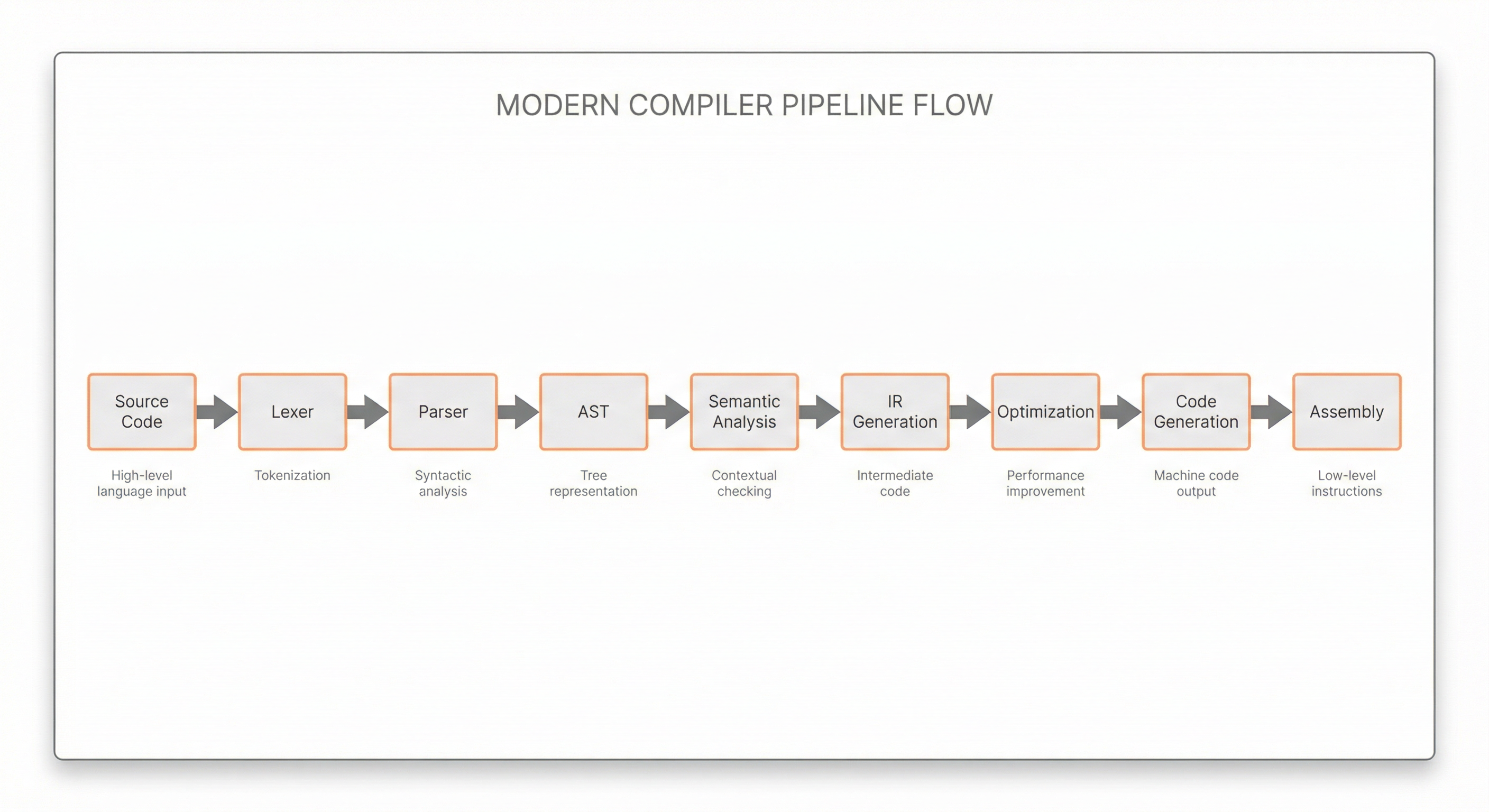
Compilation Pipeline
1. Lexical Analysis (Lexer)
- Tokenization using finite automata
- Handling of keywords, identifiers, literals
- Comment stripping and whitespace handling
- Line and column tracking for error messages
2. Parsing (Parser)
- Recursive descent parser
- Abstract Syntax Tree (AST) construction
- Operator precedence handling
- Error recovery and reporting
3. Semantic Analysis
- Symbol table management
- Type checking and inference
- Scope resolution
- Declaration before use verification
4. Intermediate Representation
- LLVM-style three-address code
- Static Single Assignment (SSA) form
- Control flow graph construction
- Basic block identification
5. Optimization Passes
- Constant folding
- Dead code elimination
- Common subexpression elimination
- Copy propagation
6. Code Generation
- x86-64 assembly output
- Register allocation (linear scan)
- Instruction selection
- Stack frame management
Language Features Supported
- Data Types: int, char, arrays, pointers
- Control Flow: if/else, while, for, switch
- Functions: Declaration, definition, recursion
- Operators: Arithmetic, logical, bitwise, comparison
- Memory: Stack allocation, pointer arithmetic
Example
Input (Simple-C):
int factorial(int n) {
    if (n <= 1) return 1;
    return n * factorial(n - 1);
}
Output (x86-64):
factorial:
    pushq   %rbp
    movq    %rsp, %rbp
    cmpl    $1, %edi
    jg      .L2
    movl    $1, %eax
    jmp     .L1
.L2:
    pushq   %rdi
    subl    $1, %edi
    call    factorial
    popq    %rdi
    imull   %edi, %eax
.L1:
    popq    %rbp
    ret
Technical Stack
- Implementation: C++
- Parser Generator: Hand-written recursive descent
- IR Format: LLVM-inspired three-address code
- Target: x86-64 Linux